


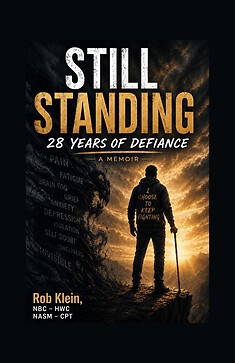
Still Standing: 28 Years of Defiance

I was 24, warming up before a company softball game, tossing the ball back and forth with a coworker. Simple stuff. I'd done it 10,000 times without thinking. But I couldn't catch the ball. Not because it was thrown badly. Because my hands weren't responding the way hands are supposed to.
I looked at my friend and said, half-joking, “Don't throw it at my face.” The second the words left my mouth, I knew it wasn't a joke.
I stepped up to bat and couldn't hit either. I was a batting champion, an all-star, a 3-sport varsity athlete with a Division II football recruitment behind me. Swinging through air at a company softball game, I still remember the hollow sound of no contact at all.
When the symptoms finally had a name
A client of mine, an ophthalmologist, noticed something was off and sent me for an MRI. A few days later he found me at the gym. I remember the weight-in, how he walked through the door. Bilateral optic neuritis, he said. Inflammation in both optic nerves, rare enough that most neurologists never see a single case in their career. And then he revealed what it most likely meant: multiple sclerosis.
I had an exercise science degree. I understood demyelination, nerve conduction, the whole clinical picture, before I ever felt it in my own body. The optic neuritis might resolve, he told me, gently. Some cases do.

The slow, relentless progression of MS
Mine never did. Twenty-eight years later, it still hasn't. I look at the world every day through what feels like a window someone breathed on and never wiped clean.
Nobody tells you MS doesn't arrive all at once. It would almost be easier if it did — one wave of grief, then you rebuild. Instead, it came slowly, one change at a time, for nearly 3 decades.
My left side took the brunt of it: grip strength, drop foot, hip surgery that rippled into chronic back pain, electrical shocks that fire with no warning and no pattern, multiple times a day. Sleep — which I understood clinically as essential medicine for a damaged nervous system — became something the disease took from me most nights.
Adapting without giving up my career
A cane entered my life when it became necessary, and I accepted it more easily than I expected. But I set it down at the gym door. Not vanity. It was a coaching decision. Clients calibrate against their trainer, whether they realize it or not.
So, I carried a plain wooden dowel onto the floor instead, using it to cue movement the way any trainer would. To anyone watching, that was exactly what it was. To me, it was a cane doing a cane's job without broadcasting it.
Finding love after an MS diagnosis
Before I met my wife, I was engaged to someone else. When my diagnosis became real to her, she asked me how she was supposed to take care of me in a wheelchair, with three kids. That wasn't cruelty — it was fear. But it told me something I carried for years: that I might be a burden. That real love might not be available to someone in my situation.
Then I met Michelle, on a blind date arranged by a coworker. We fell fast, and I was more afraid to tell her about MS than I'd been of anything the disease had actually done to me, because this time it was her choice, not mine. My clients — who'd watched me be honest about everything except this — finally pushed me: you need to tell her.
So, I did. All of it. She didn't leave. She didn't even hesitate the way I'd braced myself for.
My family became my strength
Over the years, MS renegotiated the terms of our marriage. She drives now — all of it. She cuts the grass, takes out the garbage, and does the physical work I once did without thinking. And some mornings, my kids button my shirt for me. They do it without ceremony, without making it a moment. It's just what they do because they love their father. Everything I've done since my diagnosis runs on that fuel.
Redefining success with multiple sclerosis
Here's what I know now that I didn't know at 24: You don't beat something like this. You don't leave it in the past. What you do — what I've done every day for 28 years — is try to be 1 percent better than yesterday. Not whole. Not healed. Just 1 percent more functional, more present, more useful to the people in front of me than I was the day before.
Some days MS won't allow even that. The shocks are too frequent. The fatigue sits on your chest before you open your eyes. On those days, getting through is the victory. The goal was never perfection. It's the aim — reaching for better—and on the days you can't get there, understanding you're still in the fight simply by refusing to stop trying.
What I’ve learned after 28 years
I've now lived with MS longer than I ever lived without it. It isn't a chapter in my story. It's my story. It's in every client I coach, every morning I find a way to move through a body that doesn't make it easy.
My limitations didn't stop me. They built me. And that's not a consolation prize. That's the whole point.
Join the conversation